Plant Physiology Online Test 9th Science Lesson 19 Questions in English
 Tnpsctricks
Plant Physiology Online Test 9th Science Lesson 19 Questions in English
Quiz-summary
0 of 31 questions completed
Questions:
- 1
- 2
- 3
- 4
- 5
- 6
- 7
- 8
- 9
- 10
- 11
- 12
- 13
- 14
- 15
- 16
- 17
- 18
- 19
- 20
- 21
- 22
- 23
- 24
- 25
- 26
- 27
- 28
- 29
- 30
- 31
Information
Plant Physiology Online Test 9th Science Lesson 19 Questions in English
You have already completed the quiz before. Hence you can not start it again.
Quiz is loading...
You must sign in or sign up to start the quiz.
You have to finish following quiz, to start this quiz:
Results
0 of 31 questions answered correctly
Your time:
Time has elapsed
You have reached 0 of 0 points, (0)
| Average score |
|
| Your score |
|
Categories
- Not categorized 0%
| Pos. | Name | Entered on | Points | Result |
|---|---|---|---|---|
| Table is loading | ||||
| No data available | ||||
- 1
- 2
- 3
- 4
- 5
- 6
- 7
- 8
- 9
- 10
- 11
- 12
- 13
- 14
- 15
- 16
- 17
- 18
- 19
- 20
- 21
- 22
- 23
- 24
- 25
- 26
- 27
- 28
- 29
- 30
- 31
- Answered
- Review
-
Question 1 of 31
1. Question
- What is the common name of Mimosa pudica?
Correct
Explanation
Animals move in search of food, shelter and for reproduction. Have you observed the leaves of Mimosa pudica (touch-me-not plant) closes on touching, whereas Helianthus annuus (sunflower) follows the path of the sun from dawn to dusk, (from east to west). These movements are triggered by an external stimulus.
Incorrect
Explanation
Animals move in search of food, shelter and for reproduction. Have you observed the leaves of Mimosa pudica (touch-me-not plant) closes on touching, whereas Helianthus annuus (sunflower) follows the path of the sun from dawn to dusk, (from east to west). These movements are triggered by an external stimulus.
-
Question 2 of 31
2. Question
2. For which of the following plants are sensitive?
- Light
- Gravity
- Temperature
Correct
Explanation
Unlike animals, plants do not move on their own from one place to another, but can move their body parts for getting sunlight, water and nutrients. They are sensitive to external factors like light, gravity, temperature, etc.
Incorrect
Explanation
Unlike animals, plants do not move on their own from one place to another, but can move their body parts for getting sunlight, water and nutrients. They are sensitive to external factors like light, gravity, temperature, etc.
-
Question 3 of 31
3. Question
- ______is a unidirectional movement of a whole or part of a plant.
Correct
Explanation
Tropism is a unidirectional movement of a whole or part of a plant towards the direction of stimuli. Based on the nature of stimuli, tropism can be classified into some types.
Incorrect
Explanation
Tropism is a unidirectional movement of a whole or part of a plant towards the direction of stimuli. Based on the nature of stimuli, tropism can be classified into some types.
-
Question 4 of 31
4. Question
- Assertion(A): Shoot of a plant moves towards the light is positive tropism
Reason(R): Tropism is generally termed positive if growth is towards the signal
Correct
Explanation
Tropism is generally termed positive if growth is towards the signal and negative if it is away from the signal. Shoot of a plant moves towards the light, the roots move away. Thus, the shoots are positively phototropic.
Incorrect
Explanation
Tropism is generally termed positive if growth is towards the signal and negative if it is away from the signal. Shoot of a plant moves towards the light, the roots move away. Thus, the shoots are positively phototropic.
-
Question 5 of 31
5. Question
- Which of the following are the features of shoot system of a plant?
- Positively phototropic
- Negatively geotropic
- Negatively phototropic
- Positively geotropic
Correct
Explanation
Usually shoot system of a plant is positively phototropic and negatively geotropic and root system is negatively phototropic and positively geotropic.
Incorrect
Explanation
Usually shoot system of a plant is positively phototropic and negatively geotropic and root system is negatively phototropic and positively geotropic.
-
Question 6 of 31
6. Question
- Roots of which plant turn 180° upright for respiration?
Correct
Explanation
Some halophytes produce negatively geotropic roots (e.g. Rhizophora). These roots turn 180° upright for respiration.
Incorrect
Explanation
Some halophytes produce negatively geotropic roots (e.g. Rhizophora). These roots turn 180° upright for respiration.
-
Question 7 of 31
7. Question
- Nastic movements are__________ response of a plant
Correct
Explanation
Nastic movements are non-directional response of a plant or part of a plant to stimulus. Based on the nature of stimuli, nastic movements are classified.
Incorrect
Explanation
Nastic movements are non-directional response of a plant or part of a plant to stimulus. Based on the nature of stimuli, nastic movements are classified.
-
Question 8 of 31
8. Question
- Which of the following plant flower blooms in morning and closes in the evening?
Correct
Explanation
Movement of a part of a plant in response to light is called Photonasty. e.g. Taraxacum officinale, blooms in morning and closes in the evening.
Incorrect
Explanation
Movement of a part of a plant in response to light is called Photonasty. e.g. Taraxacum officinale, blooms in morning and closes in the evening.
-
Question 9 of 31
9. Question
- Which of the following flower opens in the night and closes during the day?
Correct
Explanation
Ipomea alba (Moon flower), opens in the night and closes during the day. Movement of a part of a plant in response to light is called Photonasty.
Incorrect
Explanation
Ipomea alba (Moon flower), opens in the night and closes during the day. Movement of a part of a plant in response to light is called Photonasty.
-
Question 10 of 31
10. Question
- __________ is also known as Seismonasty
Correct
Explanation
Movement of a part of plant in response to touch is called Thigmonasty. It is also known as Seismonasty.
Incorrect
Explanation
Movement of a part of plant in response to touch is called Thigmonasty. It is also known as Seismonasty.
-
Question 11 of 31
11. Question
- Which of the following is an example of Thigmonasty?
Correct
Explanation
Movement of a part of plant in response to touch. e.g. Mimosa pudica, folds leaves and droops when touched.
Incorrect
Explanation
Movement of a part of plant in response to touch. e.g. Mimosa pudica, folds leaves and droops when touched.
-
Question 12 of 31
12. Question
- _____exhibits one of the fastest known nastic movement
Correct
Explanation
The Venus Flytrap (Dionaea muscipula) presents a spectacular example of thigmonasty. It exhibits one of the fastest known nastic movement.
Incorrect
Explanation
The Venus Flytrap (Dionaea muscipula) presents a spectacular example of thigmonasty. It exhibits one of the fastest known nastic movement.
-
Question 13 of 31
13. Question
- Which of the following are the features of Tropic movements?
- Growth dependent movements
- Temporary and reversible
- Slow action
Correct
Explanation
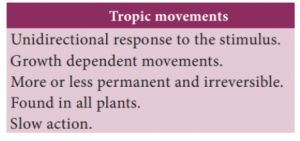 Incorrect
Explanation
-
Question 14 of 31
14. Question
- Which of the following are the features of Nastic movement?
- Immediate action
- Growth independent movements
- Found only in a few specialized plants
Correct
Explanation
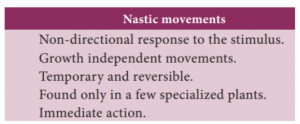 Incorrect
Explanation
-
Question 15 of 31
15. Question
- _____ bloom as the temperature increases
Correct
Explanation
Movement of part of a plant is associated with change in temperature. e.g. Tulip flowers bloom as the temperature increases.
Incorrect
Explanation
Movement of part of a plant is associated with change in temperature. e.g. Tulip flowers bloom as the temperature increases.
-
Question 16 of 31
16. Question
- What does the term ‘synthesis’ mean in photosynthesis?
Correct
Explanation
‘Photo’ means ‘light’ and ‘synthesis’ means ‘to build’. Thus, photosynthesis literally means ‘building up with the help of light’.
Incorrect
Explanation
‘Photo’ means ‘light’ and ‘synthesis’ means ‘to build’. Thus, photosynthesis literally means ‘building up with the help of light’.
-
Question 17 of 31
17. Question
- Assertion(A): Green plants are autotrophic in their mode of nutrition
Reason(R): They prepare their food materials through a process called photosynthesis
Correct
Explanation
Green plants are autotrophic in their mode of nutrition because they prepare their food materials through a process called photosynthesis. During this process, the light energy is converted into chemical energy.
Incorrect
Explanation
Green plants are autotrophic in their mode of nutrition because they prepare their food materials through a process called photosynthesis. During this process, the light energy is converted into chemical energy.
-
Question 18 of 31
18. Question
- What is the by-product of photosynthesis?
- Water
- Glucose
- Oxygen
Correct
Explanation
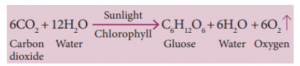 Incorrect
Explanation
-
Question 19 of 31
19. Question
- ________ have capabilities to trap solar energy
Correct
Explanation
Tel Aviv University Scientists have found out that Vespa orientalis (Oriental Hornets) have capabilities to trap solar energy.
Incorrect
Explanation
Tel Aviv University Scientists have found out that Vespa orientalis (Oriental Hornets) have capabilities to trap solar energy.
-
Question 20 of 31
20. Question
- Where part of Vespa orientalis contain yellow light sensitive pigment xanthopterin?
Correct
Explanation
Vespa orientalis (Oriental Hornets) have a yellow patch on its abdomen and an unusual cuticle structure which is a stack of 30 layers thick. The cuticle does not contain chlorophyll but it contains the yellow light sensitive pigment called xanthopterin. This works as a light harvesting molecule transforming light energy into electrical energy.
Incorrect
Explanation
Vespa orientalis (Oriental Hornets) have a yellow patch on its abdomen and an unusual cuticle structure which is a stack of 30 layers thick. The cuticle does not contain chlorophyll but it contains the yellow light sensitive pigment called xanthopterin. This works as a light harvesting molecule transforming light energy into electrical energy.
-
Question 21 of 31
21. Question
- Which of the following statement about Photosynthesis is correct?
- The end product of photosynthesis is glucose which will be converted into starch
- Plants take in carbon dioxide for photosynthesis
- For living plants also need oxygen to carry on cellular respiration
Correct
Explanation
The end product of photosynthesis is glucose which will be converted into starch and stored in the plant body. Plants take in carbon dioxide for photosynthesis; but for its living, plants also need oxygen to carry on cellular respiration.
Incorrect
Explanation
The end product of photosynthesis is glucose which will be converted into starch and stored in the plant body. Plants take in carbon dioxide for photosynthesis; but for its living, plants also need oxygen to carry on cellular respiration.
-
Question 22 of 31
22. Question
22. Which of the following are the things necessary for photosynthesis?
- Sun light
- Chlorophyll
- CO2
Correct
Explanation
Certain things are necessary for photosynthesis. They are:
- Chlorophyll – Green pigment in leaves
- Water
- Carbon dioxide (from air)
- Sun light
Incorrect
Explanation
Certain things are necessary for photosynthesis. They are:
- Chlorophyll – Green pigment in leaves
- Water
- Carbon dioxide (from air)
- Sun light
-
Question 23 of 31
23. Question
- The loss of water in the form of water vapour from the aerial parts of the plant body is called as__
Correct
Explanation
The loss of water in the form of water vapour from the aerial parts of the plant body is called as transpiration. The leaves have tiny, microscopic pores called stomata.
Incorrect
Explanation
The loss of water in the form of water vapour from the aerial parts of the plant body is called as transpiration. The leaves have tiny, microscopic pores called stomata.
-
Question 24 of 31
24. Question
- _____ % of the water transpired from leaves.
Correct
Explanation
Stomatal transpiration is the loss of water from plants through stomata. It accounts for 90- 95% of the water transpired from leaves.
Incorrect
Explanation
Stomatal transpiration is the loss of water from plants through stomata. It accounts for 90- 95% of the water transpired from leaves.
-
Question 25 of 31
25. Question
25. Which of the following statement is correct?
- The lenticels are tiny openings that protrude from the barks in woody stems and twigs
- Loss of water from plants as vapour through the lenticels is called as Lenticular transpiration
Correct
Explanation
In Lenticular transpiration, Loss of water from plants as vapour through the lenticels. The lenticels are tiny openings that protrude from the barks in woody stems and twigs as well as in other plant organs.
Incorrect
Explanation
In Lenticular transpiration, Loss of water from plants as vapour through the lenticels. The lenticels are tiny openings that protrude from the barks in woody stems and twigs as well as in other plant organs.
-
Question 26 of 31
26. Question
26. Which of the following are the reasons for transpiration?
- It creates a pull in leaf and stem
- It regulates the temperature of the plant.
- It is necessary for continuous supply of minerals
Correct
Explanation
Transpiration is necessary for the following reasons:
- It creates a pull in leaf and stem.
- It creates an absorption force in roots.
- It is necessary for continuous supply of minerals.
- It regulates the temperature of the plant.
Incorrect
Explanation
Transpiration is necessary for the following reasons:
- It creates a pull in leaf and stem.
- It creates an absorption force in roots.
- It is necessary for continuous supply of minerals.
- It regulates the temperature of the plant.
-
Question 27 of 31
27. Question
- The leaves have minute pores called as_______
Correct
Explanation
The leaves have minute pores called stomata through which the exchange of air takes place. These minute pores can be seen through a microscope.
Incorrect
Explanation
The leaves have minute pores called stomata through which the exchange of air takes place. These minute pores can be seen through a microscope.
-
Question 28 of 31
28. Question
28. Which of the following statement is correct?
- Air exchange takes place continuously through the stomata.
- Plants exchange gases (CO2 to O2) continuously through these stomata.
Correct
Explanation
Air exchange takes place continuously through the stomata. Plants exchange gases (CO2 to O2) continuously through these stomata. You will study more about these physiological process in your higher classes.
Incorrect
Explanation
Air exchange takes place continuously through the stomata. Plants exchange gases (CO2 to O2) continuously through these stomata. You will study more about these physiological process in your higher classes.
-
Question 29 of 31
29. Question
- Which of the following is an example of Phototropism?
Correct
Explanation
Phototropism is the movement of a plant part towards light. e.g. shoot of a plant. Geotropism is the movement of a plant in response to gravity. e.g. root of a plant.
Incorrect
Explanation
Phototropism is the movement of a plant part towards light. e.g. shoot of a plant. Geotropism is the movement of a plant in response to gravity. e.g. root of a plant.
-
Question 30 of 31
30. Question
- Growth of a pollen tube in response to sugar present on the stigma is an example of__
Correct
Explanation
Movement of a part of plant in response to chemicals is called as Chemotropism. e.g. growth of a pollen tube in response to sugar present on the stigma.
Incorrect
Explanation
Movement of a part of plant in response to chemicals is called as Chemotropism. e.g. growth of a pollen tube in response to sugar present on the stigma.
-
Question 31 of 31
31. Question
- Movement of a plant part due to touch is called as______
Correct
Explanation
Thigmotropism is the movement of a plant part due to touch. e.g. climbing vines. Hydrotropism is the movement of a plant or part of a plant towards water. e.g. root of a plant.
Incorrect
Explanation
Thigmotropism is the movement of a plant part due to touch. e.g. climbing vines. Hydrotropism is the movement of a plant or part of a plant towards water. e.g. root of a plant.
Leaderboard: Plant Physiology Online Test 9th Science Lesson 19 Questions in English
| Pos. | Name | Entered on | Points | Result |
|---|---|---|---|---|
| Table is loading | ||||
| No data available | ||||
Tnpsctricks