Electric Charge And Electric Current Online Test 9th Science Lesson 4 Questions in English
 Tnpsctricks
Electric Charge And Electric Current Online Test 9th Science Lesson 4 Questions in English
Quiz-summary
0 of 45 questions completed
Questions:
- 1
- 2
- 3
- 4
- 5
- 6
- 7
- 8
- 9
- 10
- 11
- 12
- 13
- 14
- 15
- 16
- 17
- 18
- 19
- 20
- 21
- 22
- 23
- 24
- 25
- 26
- 27
- 28
- 29
- 30
- 31
- 32
- 33
- 34
- 35
- 36
- 37
- 38
- 39
- 40
- 41
- 42
- 43
- 44
- 45
Information
AAZZAAZZ
You have already completed the quiz before. Hence you can not start it again.
Quiz is loading...
You must sign in or sign up to start the quiz.
You have to finish following quiz, to start this quiz:
Results
0 of 45 questions answered correctly
Your time:
Time has elapsed
You have reached 0 of 0 points, (0)
| Average score |
|
| Your score |
|
Categories
- Not categorized 0%
| Pos. | Name | Entered on | Points | Result |
|---|---|---|---|---|
| Table is loading | ||||
| No data available | ||||
- 1
- 2
- 3
- 4
- 5
- 6
- 7
- 8
- 9
- 10
- 11
- 12
- 13
- 14
- 15
- 16
- 17
- 18
- 19
- 20
- 21
- 22
- 23
- 24
- 25
- 26
- 27
- 28
- 29
- 30
- 31
- 32
- 33
- 34
- 35
- 36
- 37
- 38
- 39
- 40
- 41
- 42
- 43
- 44
- 45
- Answered
- Review
-
Question 1 of 45
1. Question
1. Which of the following statement is correct?
1. Atoms have particles like electrons, protons and neutrons.
2. Neutrons has both positive and negative charge
3. An electric current consists of moving electric charges.Correct
Like mass and length, electric charge also is a fundamental property of all matter. We know that matter is made up of atoms and molecules. Atoms have particles like electrons, protons and neutrons. By nature, electrons and protons have negative and positive charge respectively and neutrons do not have charge. An electric current consists of moving electric charges. Electricity is an important source of energy in the modern times.
Incorrect
Like mass and length, electric charge also is a fundamental property of all matter. We know that matter is made up of atoms and molecules. Atoms have particles like electrons, protons and neutrons. By nature, electrons and protons have negative and positive charge respectively and neutrons do not have charge. An electric current consists of moving electric charges. Electricity is an important source of energy in the modern times.
-
Question 2 of 45
2. Question
2. Which of the following are present in a nucleus of an atom?
1. Electron
2. Neutron
3. ProtonCorrect
Inside each atom there is a nucleus with positively charged protons and chargeless neutrons and negatively charged electrons orbiting the nucleus. Usually there are as many electrons as there are protons and the atoms themselves are neutral.
Incorrect
Inside each atom there is a nucleus with positively charged protons and chargeless neutrons and negatively charged electrons orbiting the nucleus. Usually there are as many electrons as there are protons and the atoms themselves are neutral.
-
Question 3 of 45
3. Question
3. Assertion (A): An electron is removed from the atom is called a positive ion.
Reason (R): If an electron is removed from the atom, the atom becomes positively chargedCorrect
If an electron is removed from the atom, the atom becomes positively charged. Then it is called a positive ion. If an electron is added in excess to an atom then the atom is negatively charged and it is called negative ion.
Incorrect
If an electron is removed from the atom, the atom becomes positively charged. Then it is called a positive ion. If an electron is added in excess to an atom then the atom is negatively charged and it is called negative ion.
-
Question 4 of 45
4. Question
4. When the comb is rubbed against hair which of the following acquires negative charge?
Correct
When you rub a plastic comb on your dry hair, the comb obtains power to attract small pieces of paper, is it not? When you rub the comb vigorously, electrons from your hair leave and accumulate on the edge of the comb. Your hair is now positively charged as it has lost electrons and the comb is negatively charged as it has gained electrons.
Incorrect
When you rub a plastic comb on your dry hair, the comb obtains power to attract small pieces of paper, is it not? When you rub the comb vigorously, electrons from your hair leave and accumulate on the edge of the comb. Your hair is now positively charged as it has lost electrons and the comb is negatively charged as it has gained electrons.
-
Question 5 of 45
5. Question
5. Which of the following statement is correct?
1. Electric charge is measured in coulomb and the symbol for the same is C
2. The charge of an electron (represented as e) is the fundamental unit with a charge equal to 1.6 × 10^19 C.
3. Any charge (q) has to be an integral multiple (n) of this fundamental unit of electron charge (e).Correct
Electric charge is measured in coulomb and the symbol for the same is C. The charge of an electron is numerically a very tiny value. The charge of an electron (represented as e) is the fundamental unit with a charge equal to 1.6 × 10^–19 C. This indicates that any charge (q) has to be an integral multiple (n) of this fundamental unit of electron charge (e). q = ne. Here, n is a whole number.
Incorrect
Electric charge is measured in coulomb and the symbol for the same is C. The charge of an electron is numerically a very tiny value. The charge of an electron (represented as e) is the fundamental unit with a charge equal to 1.6 × 10^–19 C. This indicates that any charge (q) has to be an integral multiple (n) of this fundamental unit of electron charge (e). q = ne. Here, n is a whole number.
-
Question 6 of 45
6. Question
6. How many electrons will be there in one coulomb of charge?
Correct
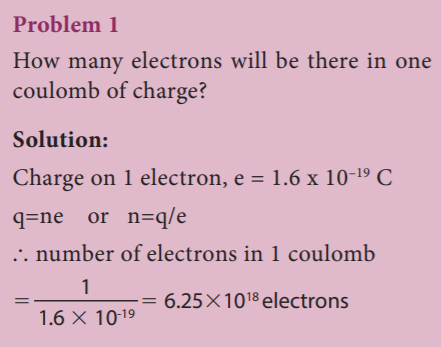 Incorrect
-
Question 7 of 45
7. Question
7. Electrostatic forces between two-point charges obey____
Correct
Electrostatic forces between two-point charges obey Newton’s third law. The force on one charge is the action and on the other is reaction and vice versa.
Incorrect
Electrostatic forces between two-point charges obey Newton’s third law. The force on one charge is the action and on the other is reaction and vice versa.
-
Question 8 of 45
8. Question
8. Which of the following statement is correct?
1. Electric charge is additive in nature
2. Practically, we have µC (micro coulomb), nC (nano coulomb) and pC (pico coulomb) as units of electric charge.Correct
Practically, we have µC (micro coulomb), nC (nano coulomb) and pC (pico coulomb) as units of electric charge. 1 µC = 10-6 C, 1nC=10-9 and 1pC = 10-12C Electric charge is additive in nature. The total electric charge of a system is the algebraic sum of all the charges located in the system. For example, let us say that a system has two charges +5C and –2C. Then the total or net charge on the system is, (+5C) + (–2C) = +3C.
Incorrect
Practically, we have µC (micro coulomb), nC (nano coulomb) and pC (pico coulomb) as units of electric charge. 1 µC = 10-6 C, 1nC=10-9 and 1pC = 10-12C Electric charge is additive in nature. The total electric charge of a system is the algebraic sum of all the charges located in the system. For example, let us say that a system has two charges +5C and –2C. Then the total or net charge on the system is, (+5C) + (–2C) = +3C.
-
Question 9 of 45
9. Question
9. Assertion(A): Two charges are not in contact they experience electric force
Reason(R): Electric force can be experienced even when the charges are not in contact.Correct
Among electric charges, there are two types of electric force (F): one is attractive and the other is repulsive. The like charges repel and unlike charges attract. The force existing between the charges is called as ‘electric force’. These forces can be experienced even when the charges are not in contact.
Incorrect
Among electric charges, there are two types of electric force (F): one is attractive and the other is repulsive. The like charges repel and unlike charges attract. The force existing between the charges is called as ‘electric force’. These forces can be experienced even when the charges are not in contact.
-
Question 10 of 45
10. Question
10. Which of the following statement is correct?
1. The region in which a charge experiences electric force forms the ‘electric field’ around the charge
2. The direction of the electric field is the direction of the force that would act on a small positive charge
3. The electric lines of force are straight or curved paths along which a unit positive charge tends to move in the electric field.Correct
The region in which a charge experiences electric force forms the ‘electric field’ around the charge. Often electric field (E) is represented by lines and arrowheads indicating the direction of the electric filed. The direction of the electric field is the direction of the force that would act on a small positive charge. Therefore, the lines representing the electric field are called ‘electric lines of force’. The electric lines of force are straight or curved paths along which a unit positive charge tends to move in the electric field. Electric lines of force are imaginary lines.
Incorrect
The region in which a charge experiences electric force forms the ‘electric field’ around the charge. Often electric field (E) is represented by lines and arrowheads indicating the direction of the electric filed. The direction of the electric field is the direction of the force that would act on a small positive charge. Therefore, the lines representing the electric field are called ‘electric lines of force’. The electric lines of force are straight or curved paths along which a unit positive charge tends to move in the electric field. Electric lines of force are imaginary lines.
-
Question 11 of 45
11. Question
11. For an isolated negative charge electric lines of force are radially__________
Correct
The strength of an electric field is represented by how close the field lines are to one another. For an isolated positive charge, the electric lines of force are radially outwards and for an isolated negative charge they are radially inwards.
Incorrect
The strength of an electric field is represented by how close the field lines are to one another. For an isolated positive charge, the electric lines of force are radially outwards and for an isolated negative charge they are radially inwards.
-
Question 12 of 45
12. Question
12. ______at a point is a measure of force acting on a unit positive charge placed at that point.
Correct
Electric field at a point is a measure of force acting on a unit positive charge placed at that point. A positive charge will experience force in the direction of electric field and a negative charge will experience in the opposite direction of electric field.
Incorrect
Electric field at a point is a measure of force acting on a unit positive charge placed at that point. A positive charge will experience force in the direction of electric field and a negative charge will experience in the opposite direction of electric field.
-
Question 13 of 45
13. Question
13. _____ is a measure of the work done on unit positive charge to bring it to that point against all
electrical forcesCorrect
Though there is an electric force (either attractive or repulsive) existing among the charges, they are still kept together. We now know that in the region of electric charge there is an electric field. Other charges experience force in this field and vice versa. There is a work done on the charges to keep them together. This results in a quantity called ‘electric potential’. Electric potential is a measure of the work done on unit positive charge to bring it to that point against all electrical forces.
Incorrect
Though there is an electric force (either attractive or repulsive) existing among the charges, they are still kept together. We now know that in the region of electric charge there is an electric field. Other charges experience force in this field and vice versa. There is a work done on the charges to keep them together. This results in a quantity called ‘electric potential’. Electric potential is a measure of the work done on unit positive charge to bring it to that point against all electrical forces.
-
Question 14 of 45
14. Question
14. Which of the following statement is correct?
1. When the charged object is provided with a conducting path, electrons start to flow through the path from lower potential to higher potential region
2. Potential difference is produced by a cell or battery.
3. Electric current is formed by moving electrons.Correct
When the charged object is provided with a conducting path, electrons start to flow through the path from higher potential to lower potential region. Normally, the potential difference is produced by a cell or battery. When the electrons move, we say that an electric current is produced. That is, an electric current is formed by moving electrons.
Incorrect
When the charged object is provided with a conducting path, electrons start to flow through the path from higher potential to lower potential region. Normally, the potential difference is produced by a cell or battery. When the electrons move, we say that an electric current is produced. That is, an electric current is formed by moving electrons.
-
Question 15 of 45
15. Question
15. Assertion(A): In electrical circuits the positive terminal is represented by a long line and negative terminal as a short line
Reason(R): The movement of the positive charge is called as ‘conventional current’Correct
Before the discovery of the electrons, scientists believed that an electric current consisted of moving positive charges. Although we know this is wrong, the idea is still widely held, as the discovery of the flow of electrons did not affect the basic understanding of the electric current. The movement of the positive charge is called as ‘conventional current’. The flow of electrons is termed as ‘electron current’. In electrical circuits the positive terminal is represented by a long line and negative terminal as a short line. Battery is the combination of more than one cell.
Incorrect
Before the discovery of the electrons, scientists believed that an electric current consisted of moving positive charges. Although we know this is wrong, the idea is still widely held, as the discovery of the flow of electrons did not affect the basic understanding of the electric current. The movement of the positive charge is called as ‘conventional current’. The flow of electrons is termed as ‘electron current’. In electrical circuits the positive terminal is represented by a long line and negative terminal as a short line. Battery is the combination of more than one cell.
-
Question 16 of 45
16. Question
16. Which of the following is/are unit of current?
1. A
2. V
3. Cs^-1Correct
If q is the quantity of charge passing through a cross section of a wire in time t, quantity of current (I) is represented as, I = q/t The standard SI unit for current is ampere with the symbol A. Current of 1 ampere means that there is one coulomb (1C) of charge passing through a cross section of a wire every one second (1 s). 1 ampere = 1 coulomb / 1 second (or) 1 A = 1 C / 1 s = 1Cs^-1.
Incorrect
If q is the quantity of charge passing through a cross section of a wire in time t, quantity of current (I) is represented as, I = q/t The standard SI unit for current is ampere with the symbol A. Current of 1 ampere means that there is one coulomb (1C) of charge passing through a cross section of a wire every one second (1 s). 1 ampere = 1 coulomb / 1 second (or) 1 A = 1 C / 1 s = 1Cs^-1.
-
Question 17 of 45
17. Question
17. _____ is an instrument used to measure the strength of the electric current
Correct
Current is the rate at which charges flow past a point on a circuit. Ammeter is an instrument used to measure the strength of the electric current in an electric circuit.
Incorrect
Current is the rate at which charges flow past a point on a circuit. Ammeter is an instrument used to measure the strength of the electric current in an electric circuit.
-
Question 18 of 45
18. Question
18. Ammeter should be connected________ in a circuit
Correct
The ammeter is connected in series in a circuit where the current is to be found. The current flows through the positive (+) red terminal of ammeter and leaves from the negative (–) black terminal.
Incorrect
The ammeter is connected in series in a circuit where the current is to be found. The current flows through the positive (+) red terminal of ammeter and leaves from the negative (–) black terminal.
-
Question 19 of 45
19. Question
19. If, 25 C of charge is determined to pass through a wire of any cross section in 50 s, what is the
measure of current?Correct
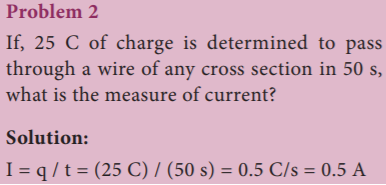 Incorrect
-
Question 20 of 45
20. Question
20. The current flowing through a lamp is 0.2A. If the lamp is switched on for one hour, what is the
total electric charge that passes through the lamp?Correct
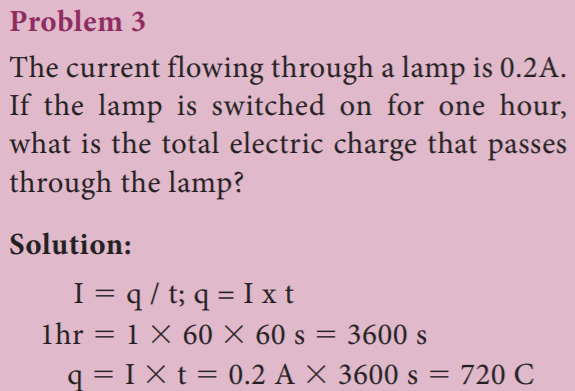 Incorrect
-
Question 21 of 45
21. Question
21. Which of the following energy can be converted from electric energy?
1. Light
2. Heat
3. MechanicalCorrect
One does not just let the circuit connect one terminal of a cell to another. Often we connect, say a bulb or a small fan or any other electrical device in an electric circuit and use the electric current to drive them. This is how a certain amount of electrical energy provided by the cell or any other source of electrical energy is converted into other form of energy like light, heat, mechanical and so on.
Incorrect
One does not just let the circuit connect one terminal of a cell to another. Often we connect, say a bulb or a small fan or any other electrical device in an electric circuit and use the electric current to drive them. This is how a certain amount of electrical energy provided by the cell or any other source of electrical energy is converted into other form of energy like light, heat, mechanical and so on.
-
Question 22 of 45
22. Question
22. What is the SI unit of e.m.f?
Correct
For each coulomb of charge passing through the light bulb (or any appliances) the amount of electrical energy converted to other forms of energy depends on the potential difference across the electrical device or any electrical component in the circuit. The potential difference is represented by the symbol V.
Incorrect
For each coulomb of charge passing through the light bulb (or any appliances) the amount of electrical energy converted to other forms of energy depends on the potential difference across the electrical device or any electrical component in the circuit. The potential difference is represented by the symbol V.
-
Question 23 of 45
23. Question
23. A charge of 2 x 10^4 C flows through an electric heater. The amount of electrical energy
converted into thermal energy is 5 3 10^6 J. What is the potential difference?Correct
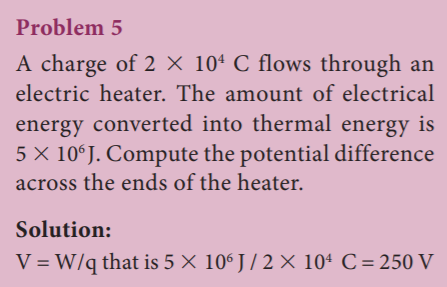 Incorrect
-
Question 24 of 45
24. Question
24. In a circuit Voltmeter should be connected in___
Correct
Voltmeter is an instrument used to measure the potential difference. To measure the potential difference across a component in a circuit, the voltmeter must be connected in parallel to it. Note the positive (+) red terminal of the voltmeter is connected to the positive side of circuit and the negative (–) black terminal is connected to the negative side of the circuit across a component
Incorrect
Voltmeter is an instrument used to measure the potential difference. To measure the potential difference across a component in a circuit, the voltmeter must be connected in parallel to it. Note the positive (+) red terminal of the voltmeter is connected to the positive side of circuit and the negative (–) black terminal is connected to the negative side of the circuit across a component
-
Question 25 of 45
25. Question
25. Which of the following has negligible resistance to electric current flow?
1. Copper
2. Aluminium
3. NichromeCorrect
The Resistance (R) is the measure of opposition offered by the component to the flow of electric current through it. Different electrical components offer different electrical resistance. Metals like copper, aluminium etc., have very much negligible resistance. That is why they are called good conductors. On the other hand, materials like nichrome, tin oxide etc., offer high resistance to the electric current. We also have a category of materials called insulators; they do not conduct electric current at all (glass, polymer, rubber and paper). All these materials are needed in electrical circuits to have usefulness and safety in electrical circuits.
Incorrect
The Resistance (R) is the measure of opposition offered by the component to the flow of electric current through it. Different electrical components offer different electrical resistance. Metals like copper, aluminium etc., have very much negligible resistance. That is why they are called good conductors. On the other hand, materials like nichrome, tin oxide etc., offer high resistance to the electric current. We also have a category of materials called insulators; they do not conduct electric current at all (glass, polymer, rubber and paper). All these materials are needed in electrical circuits to have usefulness and safety in electrical circuits.
-
Question 26 of 45
26. Question
26. Which of the following statement is correct?
1. The SI unit of resistance is ohm with the symbol (Ω).
2. The resistors can be fixed or variable
3. One ohm is the resistance of a component when the potential difference of one volt applied across the component drives a current of one ampere through itCorrect
The SI unit of resistance is ohm with the symbol (Ω). One ohm is the resistance of a component when the potential difference of one volt applied across the component drives a current of one ampere through it. We can also control the amount of flow of current in a circuit with the help of resistance. Such components used for providing resistance are called as ‘resistors’. The resistors can be fixed or variable. Fixed resistors have fixed value of resistance, while the variable resistors like rheostats can be used to obtain desired value of resistance.
Incorrect
The SI unit of resistance is ohm with the symbol (Ω). One ohm is the resistance of a component when the potential difference of one volt applied across the component drives a current of one ampere through it. We can also control the amount of flow of current in a circuit with the help of resistance. Such components used for providing resistance are called as ‘resistors’. The resistors can be fixed or variable. Fixed resistors have fixed value of resistance, while the variable resistors like rheostats can be used to obtain desired value of resistance.
-
Question 27 of 45
27. Question
27. Assertion(A): As both e.m.f and potential difference are measured in volt, they may appear the Same
Reason(R): e.m.f refers to the voltage developed across the terminals of an electrical source and potential difference refers to the voltage developed between any two points (even across electrical devices) in an electric circuitCorrect
As both e.m.f and potential difference are measured in volt, they may appear the same. But they are not. The e.m.f refers to the voltage developed across the terminals of an electrical source when it does not produce current in the circuit. Potential difference refers to the voltage developed between any two points (even across electrical devices) in an electric circuit when there is current in the circuit.
Incorrect
As both e.m.f and potential difference are measured in volt, they may appear the same. But they are not. The e.m.f refers to the voltage developed across the terminals of an electrical source when it does not produce current in the circuit. Potential difference refers to the voltage developed between any two points (even across electrical devices) in an electric circuit when there is current in the circuit.
-
Question 28 of 45
28. Question
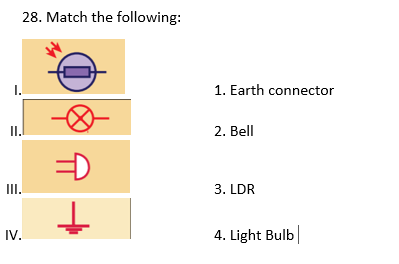 Correct
Incorrect
-
Question 29 of 45
29. Question
- Which of the following statement about series network is correct?
- In a series circuit the components are connected one after another in a single loop
- From the above we can know that the current I all along the series circuit remain same
- In a series circuit the current in each point of the circuit is same
Correct
In a series circuit the components are connected one after another in a single loop. In a series circuit there is only one pathway through which the electric charge flow. From the above we can know that the current I all along the series circuit remain same. That is in a series circuit the current in each point of the circuit is same.
Incorrect
In a series circuit the components are connected one after another in a single loop. In a series circuit there is only one pathway through which the electric charge flow. From the above we can know that the current I all along the series circuit remain same. That is in a series circuit the current in each point of the circuit is same.
-
Question 30 of 45
30. Question
30. How many minimum loops are required for parallel circuit?
Correct
In parallel circuits, the components are connected to the e.m.f source in two or more loops. In a parallel circuit there is more than one path for the electric charge to flow. In a parallel circuit the sum of the individual current in each of the parallel branches is equal to the main current flowing into or out of the parallel branches. Also, in a parallel circuit the potential difference across separate parallel branches are same.
Incorrect
In parallel circuits, the components are connected to the e.m.f source in two or more loops. In a parallel circuit there is more than one path for the electric charge to flow. In a parallel circuit the sum of the individual current in each of the parallel branches is equal to the main current flowing into or out of the parallel branches. Also, in a parallel circuit the potential difference across separate parallel branches are same.
-
Question 31 of 45
31. Question
Which of the following are effects of electric current?
- Heating effect
- Chemical effect
- Magnetic effect
Correct
When current flows in a circuit it exhibits various effects. The main effects are heating, chemical and magnetic effects.
Incorrect
When current flows in a circuit it exhibits various effects. The main effects are heating, chemical and magnetic effects.
-
Question 32 of 45
32. Question
32. Which of the following statement is correct?
1. When the flow of current is ‘resisted’ generally heat is produced
2. Work has to be done to overcome the resistance which is converted in to heat energy.
3. This conversion of electrical energy into heating energy is called ‘Joule heating’Correct
When the flow of current is ‘resisted’ generally heat is produced. This is because the electrons while moving in the wire or resistor suffer resistance. Work has to be done to overcome the resistance which is converted in to heat energy. This conversion of electrical energy into heating energy is called ‘Joule heating’ as this effect was extensively studied by the scientist Joule. This forms the principle of all electric heating appliances like iron box, water heater, toaster etc. Even connecting wires offer a small resistance to the flow of current. That is why almost all electrical appliances including the connecting wires are warm when used in an electric circuit.
Incorrect
When the flow of current is ‘resisted’ generally heat is produced. This is because the electrons while moving in the wire or resistor suffer resistance. Work has to be done to overcome the resistance which is converted in to heat energy. This conversion of electrical energy into heating energy is called ‘Joule heating’ as this effect was extensively studied by the scientist Joule. This forms the principle of all electric heating appliances like iron box, water heater, toaster etc. Even connecting wires offer a small resistance to the flow of current. That is why almost all electrical appliances including the connecting wires are warm when used in an electric circuit.
-
Question 33 of 45
33. Question
- The process of conduction of electric current through solutions is called__________
Correct
So far, we have come across the cases in which only the electrons can conduct electricity. But, here when current passes through electrolyte like copper sulphate solution, both the electron and the positive copper ion conduct electricity. The process of conduction of electric current through solutions is called ‘electrolysis’
Incorrect
So far, we have come across the cases in which only the electrons can conduct electricity. But, here when current passes through electrolyte like copper sulphate solution, both the electron and the positive copper ion conduct electricity. The process of conduction of electric current through solutions is called ‘electrolysis’
-
Question 34 of 45
34. Question
- The positive terminal inserted in to the solution is called_______
Correct
The positive terminal inserted in to the solution is called ‘anode’ and the negative terminal ‘cathode’. In the above experiment, copper wire is anode and carbon rod is cathode.
Incorrect
The positive terminal inserted in to the solution is called ‘anode’ and the negative terminal ‘cathode’. In the above experiment, copper wire is anode and carbon rod is cathode.
-
Question 35 of 45
35. Question
- Extremely weak electric current is produced in the human body are called________
Correct
Extremely weak electric current is produced in the human body by the movement of charged particles. These are called synaptic signals. These signals are produced by electro-chemical process. They travel between brain and the organs through nervous system.
Incorrect
Extremely weak electric current is produced in the human body by the movement of charged particles. These are called synaptic signals. These signals are produced by electro-chemical process. They travel between brain and the organs through nervous system.
-
Question 36 of 45
36. Question
- A wire or a conductor carrying current develops a magnetic field___ to the direction of the flow of current.
Correct
A wire or a conductor carrying current develops a magnetic field perpendicular to the direction of the flow of current. This is called magnetic effect of current. The discovery of the scientist Oersted and the ‘right hand thumb rule’ are detailed in the chapter on Magnetism and Electromagnetism. Direction of current is shown by the right-hand thumb and the direction of magnetic field is shown by other fingers of the same right hand.
Incorrect
A wire or a conductor carrying current develops a magnetic field perpendicular to the direction of the flow of current. This is called magnetic effect of current. The discovery of the scientist Oersted and the ‘right hand thumb rule’ are detailed in the chapter on Magnetism and Electromagnetism. Direction of current is shown by the right-hand thumb and the direction of magnetic field is shown by other fingers of the same right hand.
-
Question 37 of 45
37. Question
37. Which of the following statement is correct?
1. There are two distinct types of electric currents that we encounter in our everyday life: direct current (dc) and alternating current (ac).
2. Electrons move from negative terminal of the battery to positive of the battery
3. Some other sources of dc are solar cells, thermocouples etcCorrect
There are two distinct types of electric currents that we encounter in our everyday life: direct current (dc) and alternating current (ac). We know current in electrical circuits is due to the motion of positive charge from higher potential to lower potential or electron from lower to higher electrical potential. Electrons move from negative terminal of the battery to positive of the battery. Battery is used to maintain a potential difference between the two ends of the wire. Battery is one of the sources for dc current. The dc is due to the unidirectional flow of electric charges. Some other sources of dc are solar cells, thermocouples etc.
Incorrect
There are two distinct types of electric currents that we encounter in our everyday life: direct current (dc) and alternating current (ac). We know current in electrical circuits is due to the motion of positive charge from higher potential to lower potential or electron from lower to higher electrical potential. Electrons move from negative terminal of the battery to positive of the battery. Battery is used to maintain a potential difference between the two ends of the wire. Battery is one of the sources for dc current. The dc is due to the unidirectional flow of electric charges. Some other sources of dc are solar cells, thermocouples etc.
-
Question 38 of 45
38. Question
38. Which of the following works on DC?
1. Cell phones
2. Radio
3. Electric vehiclesCorrect
Many electronic circuits use dc. Some examples of devices which work on dc are cell phones, radio, electric keyboard, electric vehicles etc.
Incorrect
Many electronic circuits use dc. Some examples of devices which work on dc are cell phones, radio, electric keyboard, electric vehicles etc.
-
Question 39 of 45
39. Question
39. Which of the following statement is correct?
1. If the direction of the current in a resistor or in any other element changes its direction alternately, the current is called an alternating current
2. The alternating current varies sinusoidally with time.
3. Frequency is the number of complete cycle of variation, gone through by the ac in one secondCorrect
If the direction of the current in a resistor or in any other element changes its direction alternately, the current is called an alternating current. The alternating current varies sinusoidally with time. This variation is characterised by a term called as frequency. Frequency is the number of complete cycle of variation, gone through by the ac in one second. In ac, the electrons do not flow in one direction because the potential of the terminals vary between high and low alternately. Thus, the electrons move to and fro in the wire carrying alternating current.
Incorrect
If the direction of the current in a resistor or in any other element changes its direction alternately, the current is called an alternating current. The alternating current varies sinusoidally with time. This variation is characterised by a term called as frequency. Frequency is the number of complete cycle of variation, gone through by the ac in one second. In ac, the electrons do not flow in one direction because the potential of the terminals vary between high and low alternately. Thus, the electrons move to and fro in the wire carrying alternating current.
-
Question 40 of 45
40. Question
- The device used to convert ac to dc is called______
Correct
Domestic supply is in the form of ac. When we want to use an electrical device in dc, then we have to use a device to convert ac to dc. The device used to convert ac to dc is called rectifier. Colloquially it is called with several names like battery eliminator, dc adaptor and so on. The device used to convert dc into ac is called inverter.
Incorrect
Domestic supply is in the form of ac. When we want to use an electrical device in dc, then we have to use a device to convert ac to dc. The device used to convert ac to dc is called rectifier. Colloquially it is called with several names like battery eliminator, dc adaptor and so on. The device used to convert dc into ac is called inverter.
-
Question 41 of 45
41. Question
- What does the symbol represent?
 Correct
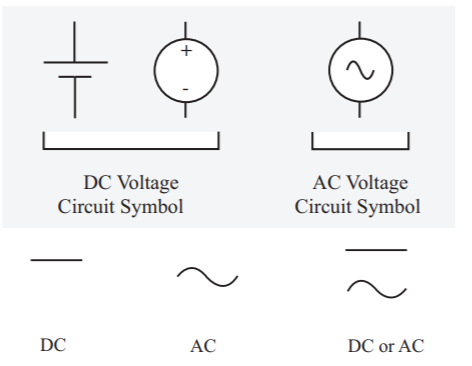 Incorrect
-
Question 42 of 45
42. Question
42. Which of the following statement is correct?
1. The voltage of ac can be varied easily using a device called transformer.
2. The ac can produce electromagnetic induction which is useful in several ways.
3. The dc can be easily converted into ac and generating dc is easier than ac.Correct
The voltage of ac can be varied easily using a device called transformer. The ac can be carried over long distances using step up transformers. The loss of energy while distributing current in the form of ac is negligible. Direct current cannot be transmitted as such. The ac can be easily converted into dc and generating ac is easier than dc. The ac can produce electromagnetic induction which is useful in several ways.
Incorrect
The voltage of ac can be varied easily using a device called transformer. The ac can be carried over long distances using step up transformers. The loss of energy while distributing current in the form of ac is negligible. Direct current cannot be transmitted as such. The ac can be easily converted into dc and generating ac is easier than dc. The ac can produce electromagnetic induction which is useful in several ways.
-
Question 43 of 45
43. Question
43. Which of the following can be done only using dc?
1. Electroplating
2. electro refining
3. electrotypingCorrect
Electroplating, electro refining and electrotyping can be done only using dc. Electricity can be stored only in the form of dc.
Incorrect
Electroplating, electro refining and electrotyping can be done only using dc. Electricity can be stored only in the form of dc.
-
Question 44 of 45
44. Question
- What is the frequency of ac used for domestic purpose in USA?
Correct
In India, the voltage and frequency of ac used for domestic purpose is 220 V and 50 Hz respectively where as in United States of America it is 110 V and 60 Hz respectively.
Incorrect
In India, the voltage and frequency of ac used for domestic purpose is 220 V and 50 Hz respectively where as in United States of America it is 110 V and 60 Hz respectively.
-
Question 45 of 45
45. Question
- What is the Resistance of a dry human body?
Correct
Resistance of a dry human body is about 1,00,000 ohm. Because of the presence of water in our body the resistance is reduced to few hundred ohm. Thus, a normal human body is a good conductor of electricity. Hence, precautions are required while doing electrical work.
Incorrect
Resistance of a dry human body is about 1,00,000 ohm. Because of the presence of water in our body the resistance is reduced to few hundred ohm. Thus, a normal human body is a good conductor of electricity. Hence, precautions are required while doing electrical work.
Leaderboard: Electric Charge And Electric Current Online Test 9th Science Lesson 4 Questions in English
| Pos. | Name | Entered on | Points | Result |
|---|---|---|---|---|
| Table is loading | ||||
| No data available | ||||
Tnpsctricks